In 2023, three small solar panel powered rovers were tested with the idea that those robots could explore the terrain of the Moon together and without direct controlling.
They are expected to go to the Moon in late 2026. The robots are powered by solar panels and mainly autonomous.
They will send information with mesh network radios between themselves and a base where people will collect the data.
Their purpose is to access crevices and craters that are hard to reach, while mapping the ground in 3d. The 3d mapping process uses navigation sensors, two stereo cameras, and a multistatic radar.
Exploring Mars
With the idea of sending them to Mars, drones have been tested in Death Valley and Mesquite Flat Sand Dunes.
Deserts were used to simulate the blank, barren terrain of Mars.
The main purpose of the deserts was to test out the Extended Robust Aerial Autonomy navigation system (ERA).
The purpose of the ERA is to increase the mobility of drones and to increase the amount of diverse terrains that the drones can explore.
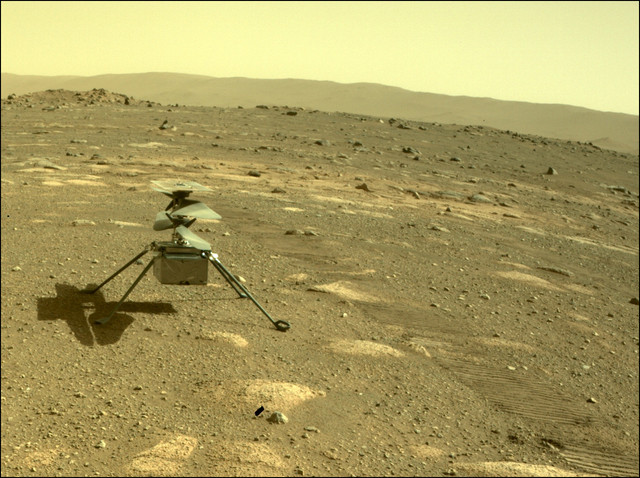
A drone-like invention has gone to mars before and was sucessfull in its mission. that drone is called the Ingenuity Mars Helecopter.
It started its journey on Mars in 2020, landed in 2021, and flew its last flight in 2024.
Ingenuity captured many photos in its time there, and the Perseverance rover helped to take photos of its journey.
Photo of Ingenuity taken by the Perseverance rover
A Very Fishy Robot
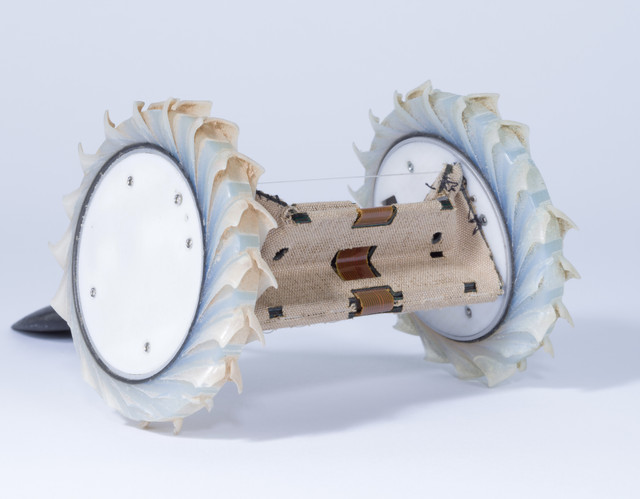
Inspired by the pufferfish and oragami, A-PUFFER is a foldable robot that is desgined to explore crevices and ditches that most robots can't reach.
A-PUFFER stands for Autonomous Pop-Up Flat Folding Explorer Robot.
The robot has a computer, as well as a wireless radio and a stereo camera.
while the robot hasn't gone and explored in space yet, it will hopefully make it to the moon, or even mars one day.
The robot is so small that it can fit into a shoebox, meaning that multiple A-PUFFER robots can be deployed and collaborate together.
The A-PUFFER has gone through many re-designs, inlcuding small changes in size, and upgrades to its wheel size.
The purpose of the stereo camera isnt for taking photos, as it helps the A-PUFFER sense the enviroment around it so it can move accordingly.
VIPER, the moon resource mapper
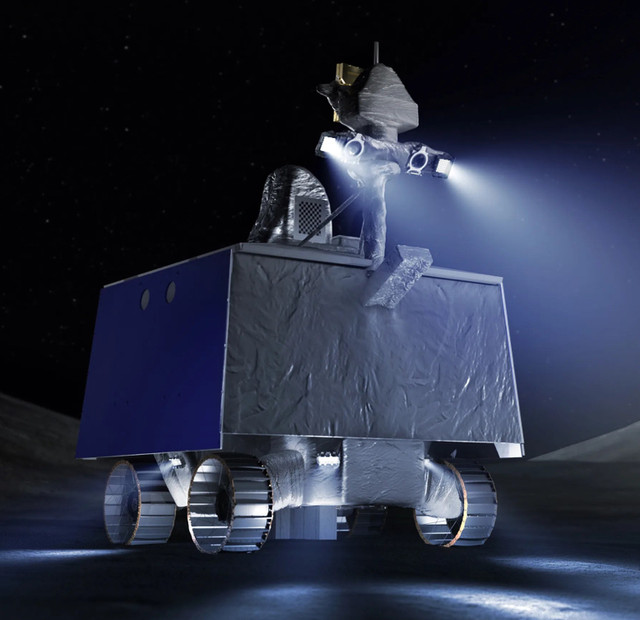
Viper is a rover that can do A LOT.
Special things that VIPER can do include:
mapping the ground, detecting ice, drilling the ice to collect samples, pulling its wheels up individually, getting out of areas with soft ground, exploring dark craters, slowing down when it detects possible samples, and a lot more!
like it is stated in the title, the VIPER is a resource mapper that is designed to locate and map water ice (and other resources) on the moon.
Due to issues with the cost and time, VIPER was originaly meant to launch in 2023, then the date was moved to 2024, the VIPER project was planned to be canceled in 2025, the project was brought back, then the launch date was set for late 2025, and now the date is in 2027.
Although there has been trial and error trying to get VIPER to the moon, when it finally lands, the information that is given to NASA will help us better understand the moon and its enviroment.
The VIPER is equipped with a 3.28-foot drill and 3 spectrometers and that will help it explore and gather data.